To read or not to read—that is the question that many students ask themselves when it comes to doing their assigned reading for classes. Many instructors have noticed a decrease in the completion of assigned reading and find this decline concerning. But perhaps a more important question than if students are doing the reading (unfortunately, all too often the answer to that question is “no” (Baron and Mangen; Johnson)), is why students aren’t completing reading assignments, and how to encourage reading completion.
Why Students Aren’t Reading
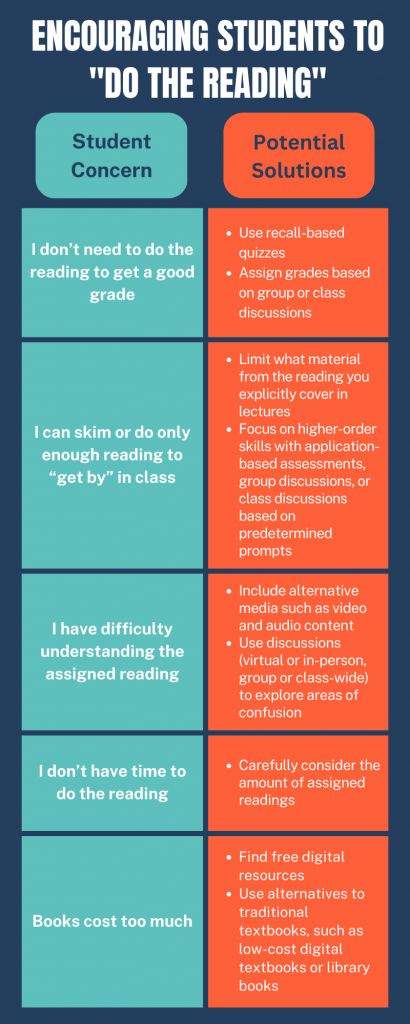
According to one recent study, students do believe reading is important to understanding a subject (Gorzycki et al.); so why do these same students not complete the assigned reading in their subjects of study? Here are some of the main reasons that students report not doing their readings:
They don’t think it’s related to class success (Gorzycki et al.) or don’t feel it’s necessary if the instructor covers the content in lectures (Johnson).
Students feel they don’t have time, so they only do as much reading as they think they need to for a certain outcome (Johnson).
They want to get the grade rather than broaden understanding and knowledge more generally, especially when the reading is for a general education course instead of a course relating to their major (Gorzycki et al.).
Some students don’t understand what they read, and they are more likely to think reading unimportant if they also don’t think they are skilled readers (Gorzycki et al.).
They feel instructors are assigning too much reading (Gorzycki et al.).
The cost of textbooks is increasing (Baron and Mangen; Johnson).
How to Encourage Students to Do the Reading
Fortunately, there are ways to help encourage students to do their assigned readings.
To address student concerns about the relationship between reading and class success, instructors can tie reading to a grade—for example, by incorporating reading comprehension–style quizzes into their curricula (Johnson).
To prevent skimming and doing only enough reading to ace a quiz, instructors can emphasize and find ways to grade higher-order skills in addition to factual recall (Johnson). These may include group discussions (either virtual or in-person), application-based assessments, or class discussions focused on prompts given to students in advance (Baron and Mangen; Gorzycki et al.).
To aid in understanding, incorporate other media (such as videos)—just make sure the rigor related to assessing student comprehension of that media is at the same level as the rest of the course (Johnson).
To address constraints on students’ time, instructors may want to carefully consider the amount of reading students are assigned. Assign enough to challenge students and convey important information, but consider trimming excess to ensure that the course can “focus on in-depth analysis” (Baron and Mangen).
To reduce monetary strain, instructors may focus on digital resources and other less expensive alternatives to full books. (Baron and Mangen).
Instructors understand the importance of reading, and here at MyEducator, we do too! To help instructors understand their students’ engagement we have several analytics tools, including tools for tracking reading, video, and assignment completion. We also offer auto-graded assessments that can be tailored to each instructor’s desired outcomes—ranging from factual recall to concept application. To see more about how analytics work on the MyEducator platform, visit our “How Do I Use MyEducator Analytics?” page. Our affordable resources just might be the right tool to help your students succeed.
Gorzycki, Meg, Desa, Geoffrey, Howard, Pamela J., and Allen, Diane D. “‘Reading Is Important,’ but ‘I Don’t Read’: Undergraduates’ Experiences with Academic Reading.” Journal of Adolescent & Adult Literacy 63, no. 5 (26 September 2019): 499–508. https://doi-org.ezproxy.lib.utah.edu/10.1002/jaal.1020