This is part 2 of a series on student health and wellness. Part 1 introduces the wellness wheel, and part 3 addresses mental health. This post addresses emotional health for students in an online setting, though these concepts apply to just about everyone!
Think about a recent setback you faced—maybe you failed a test, received some bad news at work, or had to cancel plans you were excited about. What difficult emotions surfaced for you during this time? How did you handle them? Did you write in a journal, go for a run, talk to a friend, or work even harder on the task at hand?
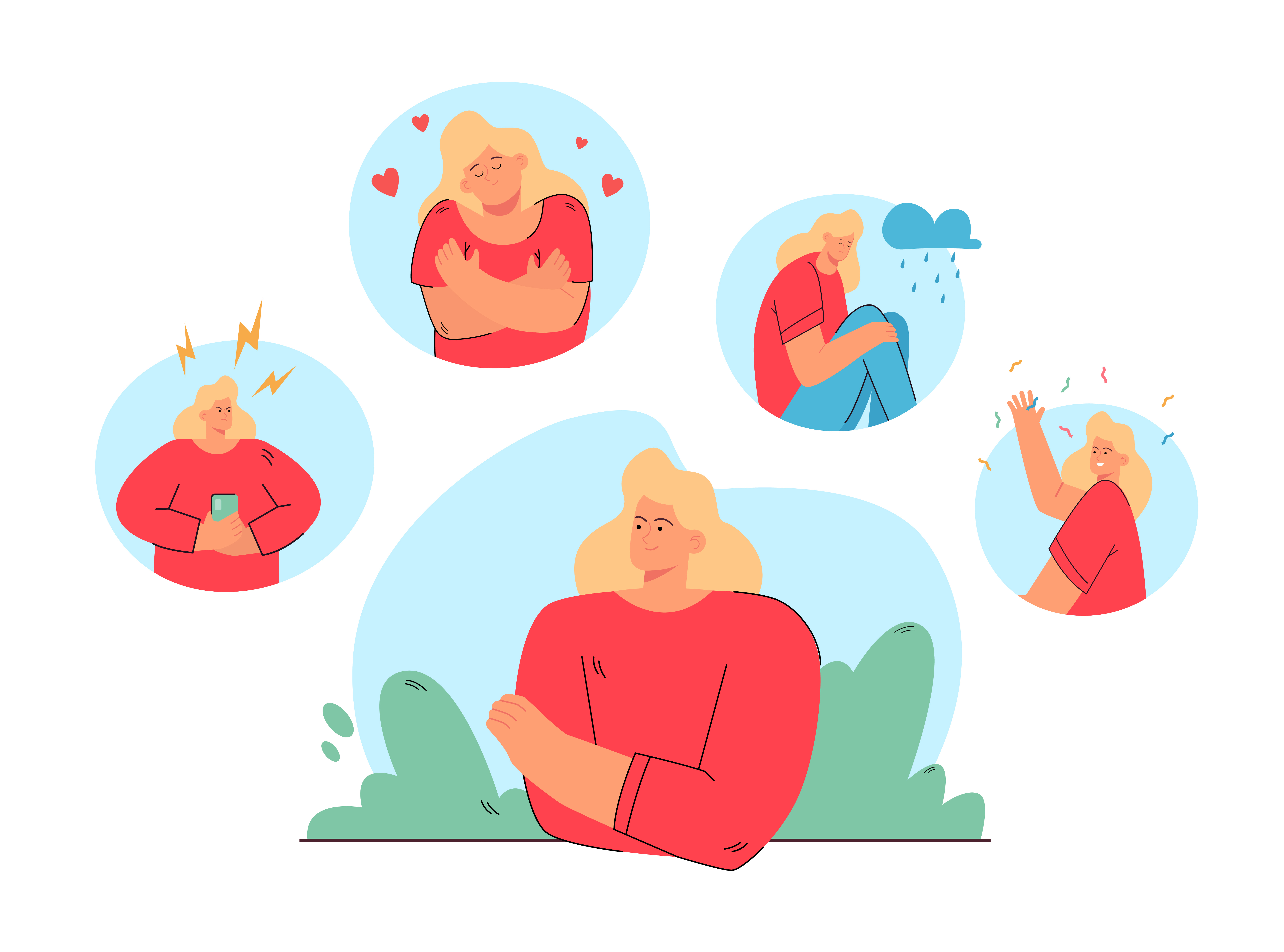
Everybody feels grief, disappointment, anger, and fear sometimes. These are normal human emotions, and an important part of our overall well-being is learning how to identify and cope with these emotions. On the other hand, everyone experiences joy, gratitude, excitement, and love—and these are an essential part of our well-being. In this post, we will define emotional well-being and discuss strategies for managing your emotional health as an online student.
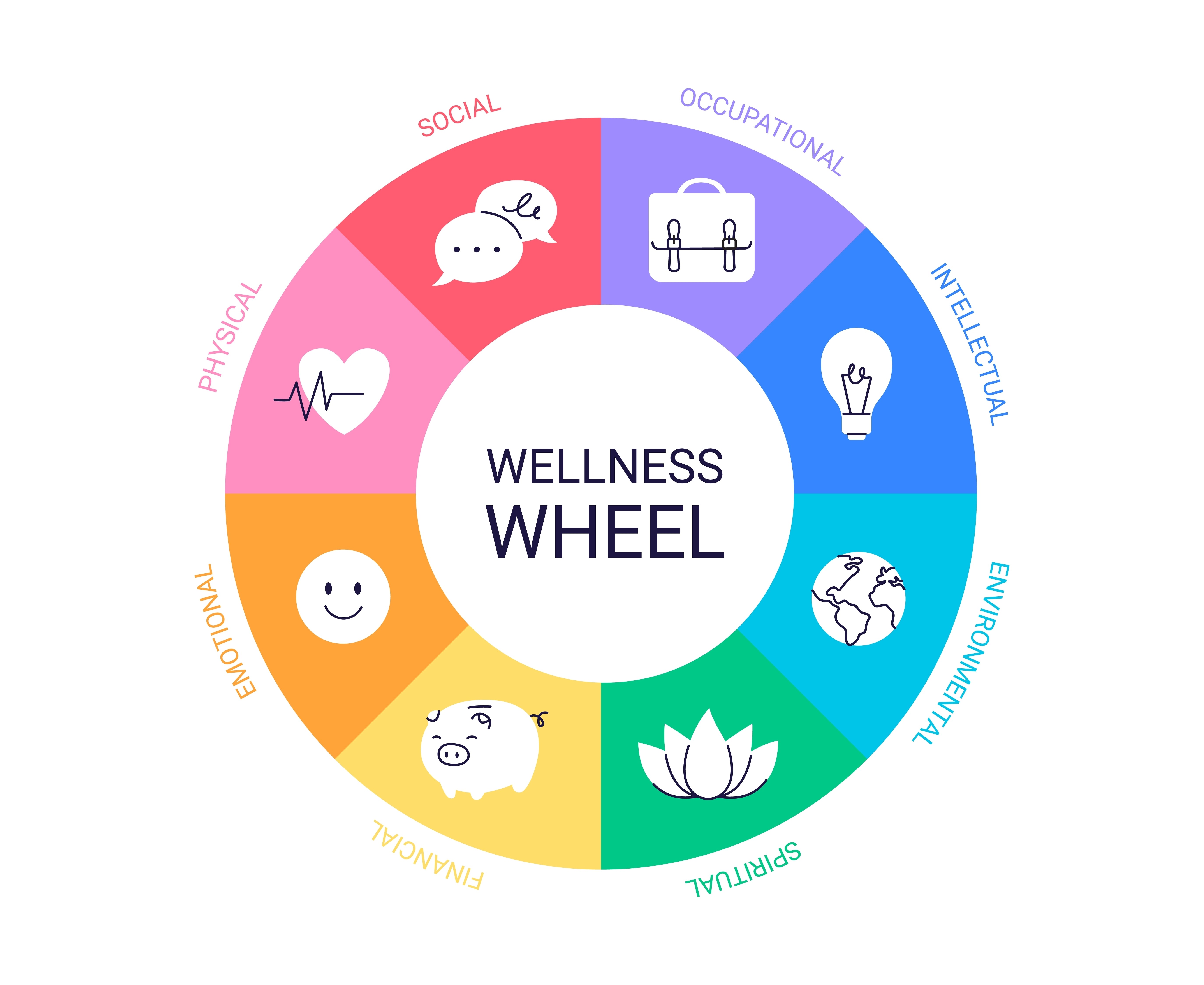
Emotional Health on the Wellness Wheel
Emotional health is the ability to effectively adapt to changes and challenges in life and experience a range of emotions in a constructive way. Emotionally healthy people are not necessarily happy 100% of the time—rather, they know how to practice self-awareness, emotional regulation, and coping skills.
Our ability to ride the waves of different emotional states sets us up for success in overcoming challenges in our academic and career pursuits and prepares us to become better business professionals. Developing emotional regulation skills allows us to take meaningful actions that align with our values, improving all parts of our well-being—from our social relationships to our financial decisions to our career outlook.
Components of Emotional Health
As a student, you may feel a range of emotions regarding your online coursework—confusion as you begin learning an unfamiliar subject, weariness as you look at your upcoming schedule, delight at receiving positive feedback from your instructor, pride when completing a difficult course or a degree program. You also probably encounter stress on a fairly regular basis!
There are a few important components that will help you learn how to integrate and understand these emotions as they arise. Emotional healthy people engage in self-awareness, learn to regulate their emotions effectively, and have a variety of coping skills available to deal with the stresses of life.
Self-Awareness
As a key component of emotional health, self-awareness is the ability to recognize your own emotions and understand why you are feeling them. Sometimes this takes practice. If you find that you have trouble putting a name to your emotions, remember that they often show up as physical sensations in the body, such as your heart rate, breathing patterns, muscle tension, and so on.
Start by paying attention to these sensations. Positive emotions feel pleasant in the body. You might feel a sensation of warmth, lightness, relaxation, or increased energy. Negative emotions are uncomfortable—you might experience a racing heart, changes in breathing, sweating, shaking, or tensing up.
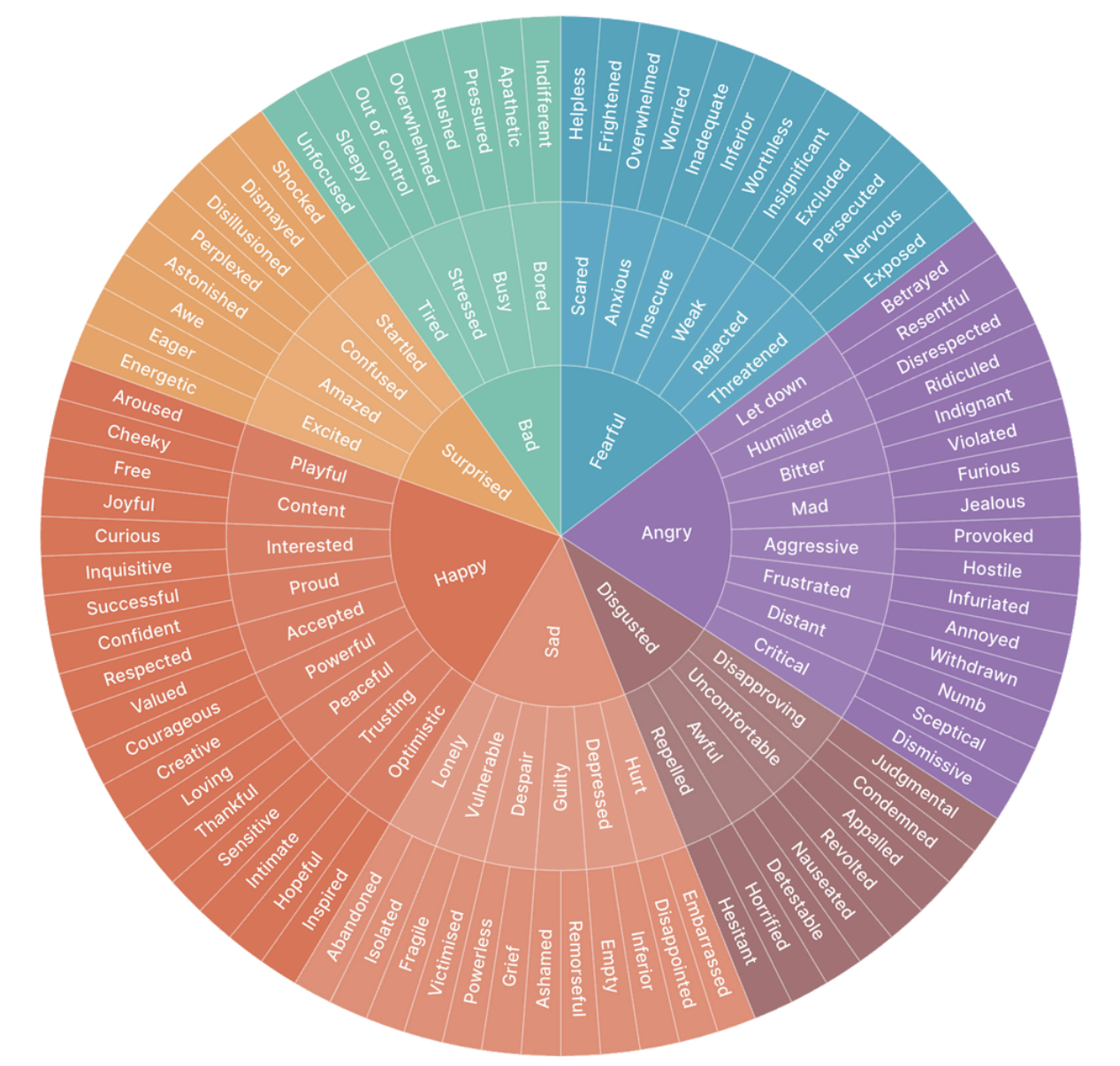
Then, try to label these feelings more specifically with an emotion word: are you happy, sad, excited, thrilled, uncertain, afraid, angry, jealous, nervous, calm, surprised? You can use an emotions wheel like the one below to identify more precisely how you are feeling.
Sometimes we try to avoid uncomfortable sensations by denying how we are feeling or powering through without stopping to check in with ourselves. However, research suggests that people who routinely deny their emotions experience increased cardiovascular risk, higher cancer rates, increased depression and anxiety, and more problems in relationships. Ignoring signs of emotional distress can lead to burnout and mental health challenges. Additionally, making space in your mind and body to be present with both pleasant and unpleasant sensations increases your ability to tolerate a wide range of emotions. Instead of avoiding, minimizing, or ignoring emotions, recognizing they exist is the first step toward effectively moving through them.
When you know what you’re feeling, you can then choose what to do with those feelings and take control over your actions. This type of self-awareness builds a foundation for developing emotional intelligence, which is critical for both personal and professional success.
Emotional Regulation
Emotional regulation is the ability to direct our emotional state, allowing us to act in ways that promote our own well-being and our relationships with others. At times you need to “down-regulate,” or lessen the intensity of an emotion like anger, in order to act wisely in a given situation. Other times you need to “up-regulate,” or increase the intensity of an emotion like excitement, in order to motivate yourself to achieve your goals. Or you might decide to reframe your thinking in a given situation to experience a different emotion altogether.
There are a variety of techniques for calming, redirecting, reframing, and problem-solving. Different techniques may work for different people and different situations, but here are a few examples of healthy emotional regulation:
Reframing thoughts. This involves exploring different ways of thinking about a situation and choosing to see opportunities for growth and learning.
Acceptance. This involves accepting emotions as they come rather than trying to deny or change them.
Mindfulness. This involves noticing emotions as they arise without judgment.
Breathing techniques. Mindful breathing exercises are one of the simplest yet most effective ways to bring the nervous system and emotions back into balance.
Taking a break. This helps your mind and body calm down so you can return to the situation with a clearer view.
Expressing emotions constructively. This involves speaking or writing calmly and assertively to communicate how you feel to others.
Problem-solving. This involves taking active steps to address the issues underlying your emotions.
Coping Skills
When we experience intense emotions—sudden anger, fear, or sadness, for example—our body activates the sympathetic nervous system. This triggers what is called the “fight-or-flight” response. The fight-or-flight response plays an important role in helping us respond to legitimately dangerous situations quickly and without conscious thought. However, in most situations, we are not in immediate physical danger, and it is difficult to make good decisions and resolve interpersonal conflict if we are constantly reacting to our circumstances in this state.
While emotional regulation deals with the way we handle our emotions, both positive and negative, coping skills include our conscious efforts to regulate our emotions under stress. There is some overlap between emotional regulation and coping skills. When it comes down to it, our emotional well-being is enhanced when we have a variety of tools to manage stress.
Emotion-Focused vs. Problem-Focused
There are two main types of coping skills. Emotion-focused coping skills help us deal with our feelings of stress, while problem-focused coping skills help us actively change the situation. For example, imagine you are working on a group project, and one group member has not turned in their part of the assignment. You are getting increasingly upset with them in group discussions and are worried about the impact on your grade. An emotion-focused coping skill would be pausing to calm down for a moment before your next group meeting. A problem-focused coping skill would be reaching out to the group member privately to ask—kindly and respectfully—about their progress on the assignment.
Here are several suggestions for healthy ways of coping with stress, depending on the situation:
Practice breathing exercises
Do yoga
Exercise or play sports
Do something creative, like art, music, or dance
Take a break
Talk to a friend
Play with a pet
Take a walk
Listen to music you enjoy
Eat a healthy snack
Find humor in the situation
Serve someone in need
Pray or meditate
Perform a random act of kindness
Brainstorm solutions
Plan out your schedule for better time management
Prioritize important tasks and decide what you can let go
Think about times you have succeeded in the past
Break down a problem or tasks into smaller pieces
Set a goal and take the first step toward accomplishing it
Note also that most of us have developed both healthy and unhealthy ways of coping with stress. Some coping methods, even if they seem positive on the surface, can be harmful when taken to extremes.
Now, check in on how you are feeling about that massive assignment due soon or that conflict you had with your roommate yesterday—what tools and strategies could you use to better manage your emotions?
Conclusion
Our emotional well-being paves the way for us to live successful, balanced lives, engage in positive relationships with others, and find meaning in our work, school, and creative activities. All the skills you build in emotional health affect your well-being in other areas. Next time, we’ll discuss how emotional health influences mental health, along with strategies for managing mental health as a student.
References
Compas, B. E., Jaser, S. S., Dunbar, J. P., Watson, K. H., Bettis, A. H., Gruhn, M. A., & Williams, E. K. (2014). Coping and emotion regulation from childhood to early adulthood: Points of convergence and divergence. Australian Journal of Psychology, 66(2), 71–81. https://doi.org/10.1111/ajpy.12043